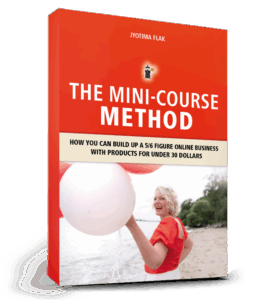
The complete guide for coaches, therapists, and online business owners.
If you want to sell digital products, attract clients automatically, and grow your online business without spending thousands on ads or complicated launches, start with a mini course.
I’m Jyotima — many people call me the Mini Course Queen, because I’ve made over €218,000 with small mini courses under €50. And today, I’ll show you exactly how you can do the same.
Mini courses are small, simple, and fast to create — yet they can generate massive long-term results when you use them with a Mini Course Funnel. Thousands of coaches and therapists use this strategy to grow their business.
In this article, you’ll learn:
What a mini course really is
Why it converts better than “normal” online courses
How the Mini Course Funnel works
Real examples from different niches
The 3 most effective upsell methods
How to turn a small offer into big clients
And how you can get the full system inside The Mini Course Method book
Let’s dive in.
What Is a Mini Course?
A mini course is a short, focused online course that solves one small problem for your ideal client. It usually costs between $27 and $47, is easy to consume, and creates a quick win.
Mini courses work because they are:
Fast to create
Easy to buy
Low risk for new customers
Highly valuable when done right
Perfect as an entry point into your business
Unlike long online courses, mini courses don’t overwhelm people. They help your customers get a result fast — and that builds trust.
Why Mini Courses Work So Well
Most coaches think: “A mini course is too small to make a difference.”
But the opposite is true.
A mini course is often the first step in your customer’s journey. Once people get a small win, they want more. This is why mini courses convert better than free content or big courses:
Customers already paid → they buy again
They get results fast → they want the next step
Trust increases → easier to sell premium offers
No chasing leads → your funnel does the work
Works for any niche → coaching, therapy, business, mindset, wellness
A mini course doesn’t sell “just a product.” It sells your method and opens the door to the rest of your business.
How the Mini Course Funnel Works
A Mini Course Funnel is simple. Think of it like a staircase:
Step 1 — Mini Course (€27–€47) Your customer buys a small transformation.
Step 2 — Upsell or Next Step Right after the purchase, you invite them to deepen their results with an upsell, workbook, or advanced training.
Step 3 — Nurture Sequence You send automation emails with tips, small wins, stories, and the next offer.
Step 4 — Premium Offer (€300–€2,000) When they’re warm, you invite them to your program, coaching, or bigger course.
This creates a smooth customer journey — without pressure or “pushy” sales.
Real Examples for Coaches and Therapists
Here are real Mini Course Funnels that work in different niches:
Stress Coach
Mini course: 10-Minute Stress Relief — $29
Upsell: Stress Workbook Bundle — $47
Premium offer: 1:1 stress coaching program — $600
Self-Worth Therapist
Mini course: 3 Exercises for Instant Confidence — $19
Upsell: Self-Worth Deep Dive — $59
Premium offer: Group program — $499
Relationship Coach
Mini course: Stop Toxic Relationship Cycle — $47
Upsell: Video series for emotional healing — $67
Premium offer: Find Your Dream Partner coaching — $1,500 or online course — $300
Small product → big client → predictable income.
The 3 Most Effective Ways to Upsell Your Mini Course
These upsell strategies increase your revenue without extra work.
1. Upsell at Checkout (Order Bump / One-Time Offer)
Example: Your customer buys a €37 mini course → You offer a workbook or video bundle for +€47 → This can double your revenue instantly.
2. Upsell Through an Email Sequence
Your customer receives:
Success stories
Extra tips
Clear next steps
Invitation to your bigger offer
Email funnels are powerful because customers are already warm and trust your method.
3. Upsell Through a Quick Webinar
Live or automated. Perfect within 14 days after the mini course purchase, because customers have momentum.
Webinar topic example: “How to Turn Your First Wins Into Lasting Change”
At the end, you present your premium program.
Why Mini Course Funnels Create Consistent Income
Mini courses create:
Passive income
Daily new customers
Automatic trust building
A clear path to higher-priced offers
Even better: once your funnel works, you can scale it with:
Organic content
YouTube
Instagram
Blog articles
Pinterest
Low-budget ads
Your mini course becomes an evergreen income system, not a one-time launch.
Want the Full System? It’s Inside The Mini Course Method
If you want to build your own Mini Course Funnel from scratch — the exact way I’ve done it for more than 13.5 years — you’ll love my book.
People call me the Mini Course Queen, because I’ve made over €218,000 with mini courses under €50. Inside my book, I show you the full process step by step.
👉 The Mini Course Method Create small digital products that turn strangers into clients — automatically.
Inside the book, you’ll learn:
How to choose the perfect mini course topic
How to structure content that converts
My exact 5-step Mini Course Funnel
How to write emails that sell
How to turn mini course buyers into 5-figure clients
Templates, checklists, examples and more
Perfect for coaches, therapists, and online entrepreneurs who want a simple, fast, profitable system.
If you’ve been dreaming about starting your online business but feel overwhelmed by the idea of creating a big course, you’re not alone. Many coaches, consultants, and entrepreneurs get stuck at the start because everything looks too complicated: tech, design, endless content.
The good news? You don’t need months or a big studio setup to launch your first product. A mini course is the perfect entry point – small, focused, and doable in just one weekend. In fact, with the right structure, you can create your very first mini course in only 3 hours.
In this article, I’ll walk you step by step through the exact process I use and teach in my Mini-Course Method. By the end, you’ll have:
A clear topic and promise
A simple outline (3–5 lessons)
Lightweight slides or a helper asset
Recorded lessons ready to share
A delivery system so you can sell your course
Let’s get started.
Why a Mini Course Is the Smartest Way to Start
Big online courses can feel overwhelming. They take months to produce and often never get finished. A mini course, on the other hand, is:
Fast to create – just 3–5 short lessons
Focused on results – one clear win for your audience
Easy to sell – low entry price, high value
Perfect for automation – can be sold 24/7 through a simple funnel
For beginners, it’s the fastest way to validate your idea and earn your first income online.
Step 1: Define Your Promise (30 minutes)
Every mini course starts with clarity. Answer this question:
“I help [who] get [result] in [timeframe] without [big obstacle].”
Examples:
“I help exhausted moms regain their energy in 7 days without restrictive diets.”
“I help new coaches book their first 3 clients this month without paid ads.”
“I help beginners meditate daily in 7 days without complicated techniques.”
Keep your promise short, clear, and specific.
Step 2: Name and Outline Your Course (30 minutes)
Pick a name that says exactly what it does. Examples:
7-Day Energy Reset
First 3 Clients
Meditation Quickstart
Then outline your course into 3–5 lessons:
Start Here (goal + roadmap)
Step 1
Step 2
Step 3
Quick Wins & Next Steps
Each lesson should be 5–10 minutes max.
Step 3: Create One Helper Asset (30 minutes)
Open Canva and make one simple worksheet, checklist, or tracker. Examples:
Daily habit tracker
Roadmap or one-page overview
Email template or journal prompts
This makes your mini course feel more valuable and helps your students get results faster.
Step 4: Record Your Lessons (60 minutes)
No fancy studio needed. Here’s what works:
Use your phone or laptop
Sit near a window for natural light
Put your phone on airplane mode
Record each lesson as a separate video
Smile, speak to one person, and keep it natural. Mistakes are okay – authenticity sells.
Step 5: Package and Deliver (30 minutes)
You now have everything you need. Here are 3 simple delivery options:
Private folder: Upload to Google Drive or Dropbox and share a private link.
Unlisted YouTube + page: Upload your lessons as unlisted videos and put them on a private page with your worksheet.
Simple storefront: Use a basic checkout tool so buyers get automatic access after purchase.
Start with a beginner-friendly price: $9–$49.
Example: Meditation Quickstart
Promise: “Learn to meditate daily in 7 days—no apps, no complicated techniques.”
Lessons:
Start Here: Set your 7-day plan
5-minute breath method
What to do when your mind races
Create your mini routine
Staying consistent after 7 days
Helper Asset: A one-page 7-day tracker
Price: $19 for first buyers
Your 3-Hour Sprint Checklist
✔ 30 min: Define your promise + course name ✔ 30 min: Outline 3–5 lessons ✔ 30 min: Create one worksheet ✔ 60 min: Record your lessons ✔ 30 min: Package, price, and deliver
Done. Your first digital product is ready.
Next Steps
You just created your first mini course in 3 hours. Imagine what’s possible if you put this into a system that works for you every day – reaching clients, making sales, and giving you more freedom.
If you want the full roadmap, check out my book The Mini-Course Method – where I teach you how to scale with automation and create a real freedom business.
Small courses build trust fast and attract premium clients — without months of work. The Mini-Course Method is a repeatable, strategic approach to creating low-ticket mini courses that convert, nurture, and scale. In this long-form article, you’ll learn why mini courses, digital products, and low-ticket offers work, see real-life examples, and get an actionable strategy to use mini courses as the gateway to higher-ticket offers.
Why the Mini-Course Method works
The Mini-Course Method focuses on fast creation, immediate value delivery, and strategic funneling. Mini courses (aka small courses, low-ticket offers, digital products) are quick to produce, easy for your audience to buy, and powerful at building trust. This is especially true for coaches, therapists, and creators who need to demonstrate results before clients invest in premium programs.
Quick wins beat perfect products
When you create a mini course, your audience gets immediate results. That quick win builds confidence in your teaching and in you as a creator. A mini course is less about being comprehensive and more about delivering a clear, transformational result in a short time.
The common mistake: going big too soon
Many new creators assume they must launch a large signature program to be taken seriously. The result: months in production, technical overwhelm, and no proof of concept. With the Mini-Course Method, you validate your idea quickly, learn what sells, and iterate — all while generating income and building your audience.
Real-life examples: mini courses that attracted premium clients
Here are short case studies showing the Mini-Course Method in action:
Stress Management Coach – Created a $29 mini course “Calm Down in 10 Minutes.” Dozens signed up, and several participants purchased one-to-one coaching.
Anxiety Therapist – Launched a short audio mini course with guided exercises. Low price, high trust — several students upgraded to a $2,000 coaching package.
My results – I sold 10,000+ mini courses under €50 and generated €217,000 in revenue, plus additional income from upsells inside my evergreen funnels.
Speed of creation: Mini courses can be built in days, not months.
Low barrier to entry: A $29–$37 price point reduces friction and increases volume.
Immediate results: Participants get an ‘aha’ moment — that creates advocates.
Trust & social proof: Small course buyers become testimonials and case studies for higher-ticket offers.
How to design a mini course
Follow this simple structure to design a converting mini course:
Step 1 – Choose a single outcome
Pick one specific result your audience wants (e.g., “Create a journal in 3 hours,” “Reduce evening anxiety in 10 minutes”). Your mini course should promise and deliver that one outcome.
Step 2 – Break it into 3–5 micro-lessons
Each lesson should be practical and action-oriented. Micro-lessons keep production time low and ensure students see progress fast.
Step 3 – Deliver formats that fit your audience
Video, audio, PDFs, or a combination. Therapists may prefer audio exercises; coaches often use short video lessons and worksheets.
Step 4 – Add one clear next step (upsell)
At the end of the mini course, present a clear next step: a premium course, a group program, or one-to-one coaching. The mini course is the entry point for client acquisition and higher-ticket sales.
Pro tip: Use an email sequence after purchase to nurture students for 7–14 days – deliver extra value, show transformations, then invite them to your offer.
Marketing the mini course
Mini courses work best inside a simple funnel:
Ad or organic post → Landing page with strong value proposition → Mini course checkout
Post-purchase email sequence → Upsell to a higher-value offer
Optional webinar or workshop to convert buyers into higher-ticket clients
Because mini courses are low-ticket, you can afford paid traffic tests and fast iteration. Track conversions and tweak messaging until you find a winning angle.
Here are topic ideas that work well as mini courses for coaches and therapists:
“Create your first journal in 3 hours” (KDP / low content)
“5-minute anxiety relief audio exercises”
“Quick client intake template + first session plan”
“From idea to first sale: Your 7-step mini product checklist”
Measuring success
Core metrics to track:
Conversion rate on the mini-course landing page
Average order value (AOV)
Upsell conversion rate to premium offers
Return on ad spend (ROAS) for paid campaigns
Small wins compound: a reliable mini course with a consistent upsell will steadily grow revenue and client acquisition.
Common objections & how to answer them
“Will a mini course make me look cheap?” – No. With professional branding and clear outcomes, mini courses position you as practical and results-driven. The Mini-Course Method demonstrates proof of concept.
“Will people buy low-ticket and never upgrade?” – Some will, but many buyers value the low-risk entry and then upgrade when they see real results. A focused upsell strategy increases upgrades.
FAQ: Mini-Course Method
Q: What is the Mini-Course Method? A: A strategy to create low-ticket, high-value mini courses that attract clients, build trust, and feed higher-ticket offers.
Q: Do mini courses really attract premium clients? A: Yes. Small courses serve as a gateway: clients experience value first, then invest in premium programs.
Q: How much should a mini course cost? A: Typically $29–$37 works best for low-barrier entry, but you can adjust based on niche and audience.
Conclusion: Start small, scale strategically
If you’ve been waiting to build the perfect flagship course, stop waiting. The Mini-Course Method gets you visible fast, builds trust with real results, and becomes a reliable source of premium clients. Mini courses are the beginning of a strategic ladder toward higher-ticket offerings.
Ready to build your mini course and attract premium clients?
Get the exact blueprint I used to scale my business: The Mini-Course Method. Step-by-step instructions, templates, and the funnel strategy to create mini courses that sell and convert into high-ticket clients.
To provide the best experiences, we use technologies like cookies to store and/or access device information. Consenting to these technologies will allow us to process data such as browsing behaviour or unique IDs on this site. Not consenting or withdrawing consent, may adversely affect certain features and functions.
Functional
Always active
The technical storage or access is strictly necessary for the legitimate purpose of enabling the use of a specific service explicitly requested by the subscriber or user, or for the sole purpose of carrying out the transmission of a communication over an electronic communications network.
Preferences
The technical storage or access is necessary for the legitimate purpose of storing preferences that are not requested by the subscriber or user.
Statistics
The technical storage or access that is used exclusively for statistical purposes.The technical storage or access that is used exclusively for anonymous statistical purposes. Without a subpoena, voluntary compliance on the part of your Internet Service Provider, or additional records from a third party, information stored or retrieved for this purpose alone cannot usually be used to identify you.
Marketing
The technical storage or access is required to create user profiles to send advertising, or to track the user on a website or across several websites for similar marketing purposes.