
Is a GPT Better Than an Online Course? How to Choose the Right Digital Product
Is a GPT better than an online course? With AI changing the way we create and sell digital products, it’s a question more coaches, therapists, consultants, and creators are asking. You can now create AI assistants, custom GPTs, prompt packs, ebooks, and online courses faster than ever. But just because you can create an AI product doesn’t automatically mean it’s the best choice for your business. After more than 15 years in online business, I’ve learned to start with a different question: What’s the best way to package my expertise so it helps my customers get results? Let’s look at the differences between GPTs, online courses, and tiny digital products — and how you can choose the right format for your audience.
How AI Is Changing Digital Product Creation
AI has made creating digital products much faster and more accessible. You can use AI to brainstorm product ideas, outline an ebook, draft course lessons, create worksheets, develop marketing content, or build a custom GPT that helps customers complete a specific task. That’s fantastic. I use AI tools myself to speed up my work and explore new possibilities. But there’s a potential trap: believing you have to create an AI product simply because everyone is talking about AI. The fact that a product uses artificial intelligence doesn’t automatically make it more valuable. What matters is whether it solves a real problem for your customer. If your customer needs a clear, step-by-step process, an online course might be the best solution. If they need personalized help applying a method to their own situation, an interactive GPT could be useful. And if they need a simple resource to get started, a small digital product might be all they need. The technology is not the strategy. Your customer’s problem is the strategy.
GPT vs. Online Course vs. Tiny Digital Product
Let’s make this practical. Imagine you’re a business coach, and your customer wants to create their first sales page. You could offer three different solutions.
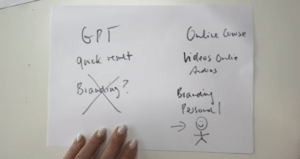
A GPT gives quick results. An online course with your videos and voice builds your personal brand.
1. An Online Course: Teach the System An online course takes your customer through a structured learning experience. You could teach them how to understand their audience, write a compelling headline, communicate the benefits of their offer, handle objections, and create a clear call to action. An online course works particularly well when your customer needs to understand a process and learn a skill step by step. It’s also a way to package your knowledge so customers can learn from you without needing to book individual sessions for every question.
2. A Tiny Digital Product: Help Them Take Action
Instead of a full course, you could create a sales page workbook, a template, a checklist, or a simple implementation guide. This gives your customer something practical to work with right away. Tiny digital products are especially useful when someone needs help completing one specific task rather than learning an entire subject. They can also be an accessible entry point into your business, allowing customers to experience your approach before investing in a larger program.
3. A Custom GPT: Provide Interactive Support
You could also create a custom GPT that asks your customer questions about their business and helps them draft their sales page. Rather than simply reading information or filling in a worksheet, the customer interacts with the tool and receives responses based on their input. A GPT can be useful when customers need guidance, ideas, or help adapting a framework to their individual circumstances. However, its quality depends on how well it’s designed, the instructions and information behind it, and the customer’s ability to review and apply its output. A GPT doesn’t automatically replace your expertise. It can help deliver parts of your method in a more interactive way. One more difference: a GPT rarely builds your personal brand. In an online course, people see your face and hear your voice, and that’s what makes them remember you
The Smartest Approach? Combine Your Digital Products
Here’s where things get interesting: you don’t necessarily have to choose just one format. You could create a small ecosystem of digital products that work together.
- Online course: Teach your method and explain the process.
- Workbook or template: Help customers implement what they’ve learned.
- Custom GPT: Give them interactive support as they apply the method to their own situation.
Each product has a different purpose, but they all help the customer move toward the same result. This approach can also create a natural product ladder. Someone might start with a low-cost template, continue with a mini-course, and later invest in a more comprehensive program. You don’t need to build everything at once. Start with one useful product, learn what your customers need, and expand when there’s a good reason to do so. If you already have an online course, adding a GPT can be the perfect reason for a new version and a re-launch.
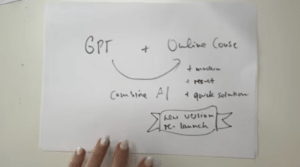
Combine AI with your existing course: more modern, a fresh reset, a quick solution, and a reason to re-launch.
Should You Create an AI Product Just Because You Can?
My answer is no. Don’t create a GPT simply because everyone else is creating GPTs. And don’t add AI to an existing offer just so you can call it an AI-powered product. Instead, ask yourself five questions:
- Does AI make the customer experience better?
- Does it save my customer time?
- Does it make implementation easier?
- Does it help personalize the process?
- Does it help the customer achieve a result more effectively?
If the answer is yes, AI might be a valuable addition. If it only makes your sales page sound more modern without improving the actual experience, you may not need it. Start with the outcome your customer wants. Then choose the format that delivers that outcome in the most useful way.
Your Expertise Is Still the Product
As AI makes information easier to access, I believe your personal expertise becomes even more important. Your experience, your perspective, your method, your stories, and your ability to understand your customers are what make your work distinctive. If you’re a coach, your experience still matters. If you’re a therapist, your professional knowledge and judgment still matter. If you’re a consultant, your methodology and understanding of your clients’ challenges still matter. AI can help you organize your knowledge, create content faster, and deliver parts of your method in new ways. But AI doesn’t magically give you expertise. You bring the knowledge, experience, and judgment. The technology helps you package and deliver them. That’s why I wouldn’t reinvent your entire business every time a new AI tool appears. Instead, look at what you already know, what your customers need, and how you can make your expertise more accessible.
How to Create Your First Digital Product Without Getting Overwhelmed
If you have lots of knowledge but aren’t sure what to turn into a digital product, start small. You don’t need a huge online course, an elaborate sales funnel, or a complicated AI system on day one. Start with these steps: Step 1: Choose one specific customer problem. Think about the questions your clients ask repeatedly. What do they struggle with? What could you help them accomplish faster? Step 2: Choose a suitable format. Would a checklist, template, ebook, mini-course, or interactive tool help them most? Choose the format based on the problem, not on what’s trending. Step 3: Create a simple first version. You can use AI to brainstorm, outline, draft, and refine your content. Add your own experience and expertise, and make sure the final product delivers real value. Step 4: Validate your idea. Talk to potential customers, gather feedback, and consider testing demand before spending weeks creating a product no one has asked for. Step 5: Make it easy to buy and use. Once your product is ready, create a clear sales page and a simple delivery process. You can automate parts of the customer journey as your business grows. You can learn more about choosing and creating your first offer in my guide to digital product ideas you can create in a weekend.
Ready to Turn Your Knowledge Into a Digital Product?
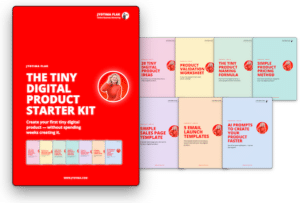
If you want to create your first digital product but feel overwhelmed by all the possibilities, I’ve created something to help you get started. My Tiny Digital Product Starter Kit includes product ideas, a validation worksheet, a naming formula, a simple pricing method, a sales page template, email launch templates, and AI prompts to help you work faster.
. 
It’s designed to help you move from an idea to a practical digital product without getting stuck in endless planning. And remember: you can absolutely use AI to help you create your product. Just don’t forget what makes it valuable in the first place. AI is the tool. Your expertise is the value. Use it to shine brighter. — Jyotima
Frequently Asked Questions
Is a GPT better than an online course?
Not necessarily. A custom GPT can provide interactive assistance for specific tasks, while an online course is often better for structured learning and step-by-step teaching. The right choice depends on your customer’s needs and the result you want to help them achieve.
Can I sell a custom GPT as a digital product?
You can build a business around GPT-based tools and AI-assisted experiences, but the best delivery and monetization options depend on the platform, its current features, and your business model. Consider access, ongoing maintenance, customer support, and the value your GPT provides before choosing your offer.
Can I combine a GPT with an online course?
Yes. An online course can teach your method, a workbook can guide implementation, and a GPT can help customers apply what they’ve learned. Combining formats can create a more useful learning experience when each element has a clear purpose.
What is the easiest digital product to create as a beginner?
A checklist, template, short ebook, or focused workbook can be a manageable starting point. Choose a specific problem you understand well, create a useful solution, and test it with your audience before investing in a larger product.
Do I need AI to create and sell digital products?
No. AI can help you research, plan, write, and organize your content, but you can create and sell digital products without it. Focus first on your audience, your expertise, and the problem you’re solving.