Do you want to turn your knowledge into a product that sells? In this free full course I show you how to create and sell digital products step by step, from your very first idea to your first sale. You can watch the complete video course right here or read the most important lessons below.
My name is Jyotima. I have been building online businesses for more than 15 years and have sold more than 12,000 courses. Everything in this guide comes from my own experience, including the mistakes I made along the way.
The full course: How to create and sell digital products
The video takes about one hour and is divided into four modules. Grab a cup of coffee, open a notebook and let’s start.
What you will learn in this course
Module 1 – The Business Model: why small digital products are the smartest way to start an online business
Module 2 – Find Your Idea: how to find a digital product idea people really want to buy
Module 3 – Create Your Product: how to create your first digital product in a weekend with Canva
Module 4 – Sell It: how to sell digital products online with a simple funnel, even without social media
Module 1: The business model that still works
If I had to start my online business again today, I would not start with a big online course. I would start with one small digital product that solves one specific problem. This is the heart of what I call the Mini-Course Method.
Why does this work so well? A small product is quick to create, easy to buy and builds trust fast. Someone buys your mini course or your PDF guide, gets a real result, and starts to trust you. From there, they are much more likely to book your coaching, join your group program or buy your bigger course.
That is why small courses bring you big clients. Your tiny product is the door into your business, and it works for coaches, therapists, consultants and every expert who wants to share their knowledge online.
Most experts don’t have a knowledge problem. They have a focus problem. They know so much that they try to put everything into their first product, and then it never gets finished.
Your customer does not want everything you know. They want one problem solved, right now. So start by listening:
Which questions do people ask you again and again?
What do they write in comments and emails?
Where do they get stuck before they could work with you?
Good digital product ideas for beginners are checklists, templates, short guides, workbooks or a mini course. Choose one problem, one clear result and one simple format.
And here is a little secret: you can sell your product before it is finished. Describe the result, open a pre-sale and create the product once the first people have bought it. That is the best way to validate your idea without wasting months of work.
Module 3: How to create your first digital product
You don’t need expensive software or months of time to create your first digital product. I like to plan it over one weekend:
Friday: choose your idea and the one result your product delivers
Saturday: create the content and design it
Sunday: set up your sales page and checkout
For the design, Canva is all you need. In the course I show you step by step how to create an ebook or PDF guide in Canva, with pages, cover and layout, even if you have never designed anything before.
AI tools like Claude or ChatGPT can help you structure your content and write faster. But remember: the AI does not replace you. Your knowledge and your experience are the real value of your digital product.
Module 4: How to sell digital products online
A great product alone doesn’t sell. You need a simple system that brings people from “I’ve never heard of you” to “I want this”. That is what a sales funnel does.
My simple 5-step funnel looks like this: people find your content, they get a free resource, they receive helpful emails, they see your offer, and they buy. Once it is set up, it works for you every day.
And the good news: you can sell digital products without social media. Search-based platforms like YouTube, Pinterest and your blog keep bringing you new people for months and years, while a social media post is forgotten after a day.
Selling also doesn’t have to feel pushy. When your products build on each other, from a small product to a mini course to your coaching, every step feels like a natural next step for your customer. No more salesy feeling.
Your next step: the Tiny Digital Product Starter Kit
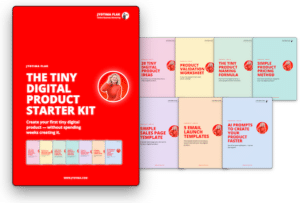
If you want to put this course into action right away, my Tiny Digital Product Starter Kit helps you do it faster. Inside you get seven tools: product ideas, a validation worksheet, a naming formula, a simple pricing method, a sales page template, five launch email templates and AI prompts that help you create everything much faster.
Digital products are products people buy and download or access online, such as ebooks, PDF guides, templates, checklists, workbooks, mini courses and online courses. You create them once and can sell them again and again.
What is the easiest digital product to create?
A checklist, a template or a short PDF guide is the easiest place to start. A mini course with a few short videos is a great next step once you know what your customers need.
Do I need a big audience to sell digital products?
No. A small, focused audience that trusts you is worth much more than a big audience that doesn’t care. With search-based content like YouTube videos and blog articles, people can find you even if you are just starting.
How much should I charge for my first digital product?
Price your product by the result it creates, not by its size. A short guide that saves your customer hours of work or stress can easily be worth more than a long ebook that solves nothing.
Can I sell digital products without social media?
Yes. With YouTube, Pinterest, a blog and an email list you can build a system that sells your digital products on autopilot, without posting on Instagram or TikTok every day.
Start small and let your business grow
You don’t need a perfect plan or a huge course to start. Find one problem, create one small digital product, and sell it with a simple system. Everything else can grow from there.
If this course helped you, subscribe to my YouTube channel. Every week I share practical tips on how to create and sell digital products, simple and step by step.
What if you could create your first digital product this weekend? Not in six months. This weekend.
I’m not talking about a big online course with forty lessons. I’m talking about a tiny digital product: one problem, one person, one solution.
I’ve been building online businesses for more than 15 years. One of my biggest lessons is this: you don’t need the whole business before you make your first sale. You can start with one useful solution.
So here’s exactly how I would do it if I had just one weekend.
Your Weekend Plan at a Glance
Before we start, here’s the whole plan in three steps:
Friday: Choose one idea
Saturday: Build the structure and create your product
Sunday: Package it and start selling
Let’s go through it day by day.
Friday: Choose Your Idea
Most people start with the wrong question: “What could I sell?”
Ask this instead: “What problem can I solve?”
The best ideas are hiding in the questions people ask you again and again:
Are you a coach? What do your clients always ask you?
Are you a therapist? What do people need help with between sessions?
Are you a consultant? Where do your clients get stuck?
Write down ten problems. Then choose one. Not five. Not ten. Just one.
Now take your one problem and break your solution into three to five simple steps.
Here’s an example. Imagine you’re a stress coach. Many of your clients can’t switch off in the evening and sleep badly. Your product could be a short guide called “Sleep Better in 3 Steps”:
Calm your mind in the evening
Build a simple bedtime routine
Handle stressful thoughts at night
And that’s it. That’s already a product.
You don’t need 27 modules. You need a clear path from A to B: from where your customer is now to where they want to be.
Saturday Afternoon: Create It (With AI as Your Assistant)
Now you create the actual product: a short ebook, a workbook, a checklist or a few videos.
This is where I use AI. But not to write everything for me. AI is my assistant, not my replacement.
Give it your notes, your process, your examples and your experience. Then ask it to help you:
structure your ideas
find what’s missing
create exercises and worksheets
make your words clearer
This saves you hours. But your expertise stays at the center. People don’t need another generic AI product. They need your solution.
Sunday is for getting your product out into the world:
✔ Give it a good name that makes people curious
✔ Create a simple sales page
✔ Add a payment button
✔ Tell people about it with a few emails or social posts
And here’s an important lesson from my experience: don’t spend the whole weekend on design.
I’ve seen people spend days on fonts, colors and Canva templates before they even knew if anyone wanted the product. Your customer isn’t buying your font. They’re buying your solution.
So make it clean, make it useful, and put it out there.
When you make your first sale, you get something even more valuable than money: information.
You see what people like. You see what questions they ask. You can improve your product and create your next offer.
Your tiny product is just the first step on your offer ladder:
Tiny product → Mini course → Group program → Coaching
You don’t need to know the whole path before you start walking. You build the path as you go. If you want to see how one idea can turn into several products, read Sell This in 2026: One Idea, Three Digital Products.
Get Started This Weekend
If you want help to start, I created the Tiny Digital Product Starter Kit. It’s made for exactly this weekend.
Inside you’ll find:
20 tiny product ideas
a worksheet to test your idea
a naming formula
a simple pricing method
a sales page template
5 email templates for your launch
AI prompts to create everything faster
It’s not another big course. It’s a toolkit you can open and work with right away.
Is a GPT Better Than an Online Course? How to Choose the Right Digital Product
Is a GPT better than an online course? With AI changing the way we create and sell digital products, it’s a question more coaches, therapists, consultants, and creators are asking. You can now create AI assistants, custom GPTs, prompt packs, ebooks, and online courses faster than ever. But just because you can create an AI product doesn’t automatically mean it’s the best choice for your business. After more than 15 years in online business, I’ve learned to start with a different question: What’s the best way to package my expertise so it helps my customers get results? Let’s look at the differences between GPTs, online courses, and tiny digital products — and how you can choose the right format for your audience.
How AI Is Changing Digital Product Creation
AI has made creating digital products much faster and more accessible. You can use AI to brainstorm product ideas, outline an ebook, draft course lessons, create worksheets, develop marketing content, or build a custom GPT that helps customers complete a specific task. That’s fantastic. I use AI tools myself to speed up my work and explore new possibilities. But there’s a potential trap: believing you have to create an AI product simply because everyone is talking about AI. The fact that a product uses artificial intelligence doesn’t automatically make it more valuable. What matters is whether it solves a real problem for your customer. If your customer needs a clear, step-by-step process, an online course might be the best solution. If they need personalized help applying a method to their own situation, an interactive GPT could be useful. And if they need a simple resource to get started, a small digital product might be all they need. The technology is not the strategy. Your customer’s problem is the strategy.
GPT vs. Online Course vs. Tiny Digital Product
Let’s make this practical. Imagine you’re a business coach, and your customer wants to create their first sales page. You could offer three different solutions.
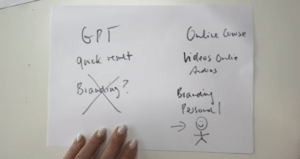
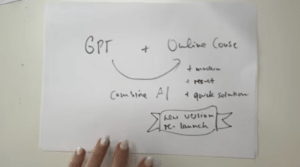
A GPT gives quick results. An online course with your videos and voice builds your personal brand.
1. An Online Course: Teach the System An online course takes your customer through a structured learning experience. You could teach them how to understand their audience, write a compelling headline, communicate the benefits of their offer, handle objections, and create a clear call to action. An online course works particularly well when your customer needs to understand a process and learn a skill step by step. It’s also a way to package your knowledge so customers can learn from you without needing to book individual sessions for every question.
2. A Tiny Digital Product: Help Them Take Action
Instead of a full course, you could create a sales page workbook, a template, a checklist, or a simple implementation guide. This gives your customer something practical to work with right away. Tiny digital products are especially useful when someone needs help completing one specific task rather than learning an entire subject. They can also be an accessible entry point into your business, allowing customers to experience your approach before investing in a larger program.
3. A Custom GPT: Provide Interactive Support
You could also create a custom GPT that asks your customer questions about their business and helps them draft their sales page. Rather than simply reading information or filling in a worksheet, the customer interacts with the tool and receives responses based on their input. A GPT can be useful when customers need guidance, ideas, or help adapting a framework to their individual circumstances. However, its quality depends on how well it’s designed, the instructions and information behind it, and the customer’s ability to review and apply its output. A GPT doesn’t automatically replace your expertise. It can help deliver parts of your method in a more interactive way. One more difference: a GPT rarely builds your personal brand. In an online course, people see your face and hear your voice, and that’s what makes them remember you
The Smartest Approach? Combine Your Digital Products
Here’s where things get interesting: you don’t necessarily have to choose just one format. You could create a small ecosystem of digital products that work together.
Online course: Teach your method and explain the process.
Workbook or template: Help customers implement what they’ve learned.
Custom GPT: Give them interactive support as they apply the method to their own situation.
Each product has a different purpose, but they all help the customer move toward the same result. This approach can also create a natural product ladder. Someone might start with a low-cost template, continue with a mini-course, and later invest in a more comprehensive program. You don’t need to build everything at once. Start with one useful product, learn what your customers need, and expand when there’s a good reason to do so. If you already have an online course, adding a GPT can be the perfect reason for a new version and a re-launch.
Combine AI with your existing course: more modern, a fresh reset, a quick solution, and a reason to re-launch.
Should You Create an AI Product Just Because You Can?
My answer is no. Don’t create a GPT simply because everyone else is creating GPTs. And don’t add AI to an existing offer just so you can call it an AI-powered product. Instead, ask yourself five questions:
Does AI make the customer experience better?
Does it save my customer time?
Does it make implementation easier?
Does it help personalize the process?
Does it help the customer achieve a result more effectively?
If the answer is yes, AI might be a valuable addition. If it only makes your sales page sound more modern without improving the actual experience, you may not need it. Start with the outcome your customer wants. Then choose the format that delivers that outcome in the most useful way.
Your Expertise Is Still the Product
As AI makes information easier to access, I believe your personal expertise becomes even more important. Your experience, your perspective, your method, your stories, and your ability to understand your customers are what make your work distinctive. If you’re a coach, your experience still matters. If you’re a therapist, your professional knowledge and judgment still matter. If you’re a consultant, your methodology and understanding of your clients’ challenges still matter. AI can help you organize your knowledge, create content faster, and deliver parts of your method in new ways. But AI doesn’t magically give you expertise. You bring the knowledge, experience, and judgment. The technology helps you package and deliver them. That’s why I wouldn’t reinvent your entire business every time a new AI tool appears. Instead, look at what you already know, what your customers need, and how you can make your expertise more accessible.
How to Create Your First Digital Product Without Getting Overwhelmed
If you have lots of knowledge but aren’t sure what to turn into a digital product, start small. You don’t need a huge online course, an elaborate sales funnel, or a complicated AI system on day one. Start with these steps: Step 1: Choose one specific customer problem. Think about the questions your clients ask repeatedly. What do they struggle with? What could you help them accomplish faster? Step 2: Choose a suitable format. Would a checklist, template, ebook, mini-course, or interactive tool help them most? Choose the format based on the problem, not on what’s trending. Step 3: Create a simple first version. You can use AI to brainstorm, outline, draft, and refine your content. Add your own experience and expertise, and make sure the final product delivers real value. Step 4: Validate your idea. Talk to potential customers, gather feedback, and consider testing demand before spending weeks creating a product no one has asked for. Step 5: Make it easy to buy and use. Once your product is ready, create a clear sales page and a simple delivery process. You can automate parts of the customer journey as your business grows. You can learn more about choosing and creating your first offer in my guide to digital product ideas you can create in a weekend.
Ready to Turn Your Knowledge Into a Digital Product?
If you want to create your first digital product but feel overwhelmed by all the possibilities, I’ve created something to help you get started. My Tiny Digital Product Starter Kit includes product ideas, a validation worksheet, a naming formula, a simple pricing method, a sales page template, email launch templates, and AI prompts to help you work faster.
.
It’s designed to help you move from an idea to a practical digital product without getting stuck in endless planning. And remember: you can absolutely use AI to help you create your product. Just don’t forget what makes it valuable in the first place. AI is the tool. Your expertise is the value. Use it to shine brighter. — Jyotima
Frequently Asked Questions
Is a GPT better than an online course?
Not necessarily. A custom GPT can provide interactive assistance for specific tasks, while an online course is often better for structured learning and step-by-step teaching. The right choice depends on your customer’s needs and the result you want to help them achieve.
Can I sell a custom GPT as a digital product?
You can build a business around GPT-based tools and AI-assisted experiences, but the best delivery and monetization options depend on the platform, its current features, and your business model. Consider access, ongoing maintenance, customer support, and the value your GPT provides before choosing your offer.
Can I combine a GPT with an online course?
Yes. An online course can teach your method, a workbook can guide implementation, and a GPT can help customers apply what they’ve learned. Combining formats can create a more useful learning experience when each element has a clear purpose.
What is the easiest digital product to create as a beginner?
A checklist, template, short ebook, or focused workbook can be a manageable starting point. Choose a specific problem you understand well, create a useful solution, and test it with your audience before investing in a larger product.
Do I need AI to create and sell digital products?
No. AI can help you research, plan, write, and organize your content, but you can create and sell digital products without it. Focus first on your audience, your expertise, and the problem you’re solving.
If you’re thinking about creating digital products in 2026, you might believe you need a massive audience, a complicated online course, or a perfectly polished brand before you can start making sales online.
The truth is much simpler than that.
You don’t need thousands of followers.
You don’t need to go viral.
And you definitely don’t need to spend six months building a giant course before earning your first dollar online.
What you need is a simple idea, a clear transformation, and the courage to start smaller than you think.
After more than 15 years in online business and selling over 12,000 digital products, I’ve learned something that completely changed the way I build products:
Small products sell faster.
Especially in 2026.
Because people are overwhelmed.
The internet is louder than ever. New trends appear every week. AI tools generate content in seconds. Everyone is promising six figures, passive income, and overnight success.
But customers are tired of complexity.
They are looking for simple solutions to specific problems.
That is exactly why tiny digital products are becoming one of the biggest opportunities for creators, coaches, therapists, consultants, and experts.
Let’s look at the three tiny digital products that are likely to perform extremely well in 2026.
Why Small Digital Products Work Better
Many people delay building their online business because the task feels enormous.
They imagine building a huge online academy with dozens of modules, memberships, communities, apps, and automations.
The result?
They never start.
Psychologically, this makes perfect sense.
When a project feels too large, our brain sees it as a threat instead of an opportunity. We overthink. We procrastinate. We wait until we feel ready.
Small products create the opposite effect.
They feel achievable.
You can finish them quickly.
You can publish them quickly.
You can test them quickly.
Most importantly, you can get your first customers quickly.
And that changes everything.
Confidence is not created by thinking.
Confidence is created by action.
Every small product you finish teaches you something valuable about your audience, your positioning, and your market.
Tiny products create momentum.
Momentum creates confidence.
Confidence creates businesses.
Tiny Digital Product #1: A Small eBook
The first tiny digital product is a focused eBook.
Not a 300-page book.
Not a complicated encyclopedia of everything you know.
A simple guide that solves one problem for one specific person.
People do not buy eBooks because they want more information.
The internet already has enough information.
People buy clarity.
They buy a shortcut.
They buy structure.
They buy a path from confusion to progress.
Ask yourself:
What is one problem I can help solve?
Your eBook could answer questions like:
How to get your first coaching clients
How to create your first meditation routine
How to improve sleep naturally
How to start an online business
How to create your first digital product
The smaller and more specific the transformation, the easier your product becomes to sell.
Your eBook is not your final destination.
It is your entry point.
Tiny Digital Product #2: A Mini Course
The second product is a mini course.
Some people love reading.
Others learn much better by watching and listening.
A mini course allows you to teach the exact same solution from your eBook in video form.
The important part is this:
You do not need a completely new idea.
The transformation stays exactly the same.
Only the learning experience changes.
Think of your mini course as a weekend transformation.
Your customer should be able to consume the content within one or two days and immediately implement what they learned.
The best mini courses focus on:
One problem
One solution
One result
Simple sells.
Complex overwhelms.
This is exactly why mini courses continue to outperform large online courses for many creators.
Tiny Digital Product #3: A Simple Membership
The third digital product is a simple membership or ongoing support program.
Many people believe memberships need hundreds of videos, communities, and complicated platforms.
They don’t.
Sometimes all people need is accountability.
Guidance.
Connection.
Support while implementing.
A membership could be:
One monthly coaching call
A small mastermind group
Weekly accountability sessions
A community with expert guidance
Information alone rarely creates transformation.
Implementation creates transformation.
And implementation becomes much easier when people feel supported.
That is why memberships continue to be one of the strongest recurring income models available.
One Idea Can Create Multiple Products
One of the biggest mistakes creators make is believing they constantly need new ideas.
You don’t.
One great idea can become an entire product ecosystem.
Imagine an apple.
You can sell:
The whole apple
Apple slices
Apple juice
Different experiences.
Same source.
The exact same principle applies to digital products.
One core transformation can become:
An eBook
A mini course
A membership
Coaching
Workshops
Group programs
The idea stays the same.
Only the format changes.
The Real Secret: Build a System
Products alone do not create freedom.
Systems create freedom.
The most successful digital businesses usually follow a simple structure:
A customer discovers your content.
They buy your entry-level product.
Trust begins to grow.
You continue supporting them.
Then, naturally, they move into your next offer.
No pressure.
No aggressive sales tactics.
No complicated launches every few months.
This is how sustainable online businesses are built.
Step by step.
Relationship by relationship.
Why This Will Work Even Better in 2026
The online world is becoming faster.
AI is creating more content than ever before.
Because of that, authenticity and simplicity are becoming more valuable.
People are no longer looking for bigger promises.
They are looking for believable solutions.
Tiny products feel achievable.
They feel safe.
And when people feel safe, they buy.
Instead of creating something new every six weeks, create one evergreen product system that can serve your audience for years.
That approach is far more sustainable and far more profitable.
Start Small and Build Your Freedom Business
If there is one thing I wish more creators understood, it is this:
You do not need to build everything at once.
Start with one idea.
Turn it into one product.
Serve one group of people.
Then improve, expand, and grow from there.
Small beginnings often create extraordinary businesses.
If you would like help creating your own mini course ecosystem, download my book:
Inside, I show you how to turn your expertise into digital products, mini courses, and automated systems that create more freedom, more impact, and more income.
Start small.
Stay consistent.
Build your lighthouse business one step at a time.
If you have been dreaming about building passive income online, creating more freedom in your daily life, and finally starting your own online business, then writing your first ebook can honestly become one of the smartest and easiest starting points. So many people delay creating digital products because they think they need a huge audience, expensive equipment, a complicated website, or months of preparation before they are “ready.” But the truth is that ebooks are often the exact opposite. They are one of the fastest digital products you can create, they are beginner-friendly, and they can become the foundation of an automated online business that keeps generating income long after you create it.
I know this because I built my own business step by step through small digital products, mini courses, and evergreen funnels. Today, I have earned over €218,000 with digital products under €50 while working around 25 hours a week as a single mother. Years ago, I believed I constantly had to trade time for money through live workshops, one-on-one coaching, or endless launches. Now my business works very differently. My ebooks, mini courses, funnels, and automated systems continue selling while I spend time with my daughter, go roller skating, walk my dog Sammy, or simply enjoy more freedom in my life. And honestly, I wish somebody had explained this entire digital product system to me much earlier.
Because once you understand how to write your first ebook and connect it to a simple evergreen funnel, you stop looking at ebooks as “small products” and start seeing them as the entry point into an entire online business ecosystem.
Why Ebooks Are Still One of the Best Digital Products for Passive Income
A lot of people underestimate ebooks because they think online courses are more valuable or because social media makes everything look bigger and more complicated than it actually needs to be. But ebooks continue to work extremely well because people are actively searching for fast solutions, practical guides, step-by-step help, templates, and inspiration they can consume quickly without feeling overwhelmed.
This is exactly why ebooks are such a powerful digital product for beginners. They are affordable, easy to buy, easy to consume, and simple to create compared to large online programs. Your reader gets a quick transformation, while you create something scalable that can sell repeatedly without you needing to show up live every single time.
An ebook can also become much more than a standalone product. Once you create one ebook, you can turn the same topic into:
a mini course
a workbook
an audio product
templates
coaching offers
memberships
workshops
evergreen email funnels
upsells and order bumps
This is where passive income online starts becoming realistic. You stop relying only on active work and begin building systems that continue selling automatically.
The Biggest Mistake People Make When Writing Their First Ebook
One of the biggest reasons why many ebooks never sell is because the topic is far too broad. People often try to create an ebook that helps everyone with everything, which usually makes the offer confusing and forgettable.
Successful ebooks are much more specific.
Instead of creating an ebook about “personal growth,” you could create:
journaling prompts for anxiety
nervous system regulation for busy moms
beginner meal planning
Instagram captions for coaches
breathwork for stress relief
passive income ideas for creatives
ebook marketing for beginners
The clearer your topic becomes, the easier it is for potential buyers to immediately understand how your ebook can help them. This clarity is one of the most important parts of building a successful digital product business because people buy solutions to very specific problems.
Whenever I create digital products, I always ask myself:
What are people constantly asking me about? What transformation feels easy for me but difficult for others? What problem have I already solved in my own life that could help somebody else move forward faster?
This creates products that feel practical, personal, and valuable at the same time.
Create Your Ebook Around One Specific Transformation
The easiest way to write your first ebook quickly is by focusing on one small transformation instead of trying to teach everything you know at once.
Your ebook does not need to completely change someone’s entire life overnight. It simply needs to help your reader move from one situation to another situation more easily.
For example:
from overwhelmed to organized
from stressed to calmer
from confused to clear
from stuck to taking action
from inconsistent to productive
This transformation is what people are really buying.
A very helpful formula for creating ebook clarity is:
“I help [person] achieve [result] through [method].”
For example:
“I help coaches create mini courses and evergreen funnels with simple digital product strategies.”
Once you know this sentence, your ebook content becomes much easier to structure because you already know:
who the ebook is for
what result it creates
how you help the reader achieve it
How to Write Your First Ebook in One Day
Yes, it is completely possible to write your first ebook in one day, especially when you stop overthinking perfection and start focusing on clarity and implementation.
Most people delay writing because they imagine ebooks as huge complicated projects. But your first ebook does not need 200 pages. In fact, shorter ebooks often perform better because readers want fast wins and practical help they can implement immediately.
The fastest way to begin is by outlining 3–5 simple chapters around your topic. Start with the problem your audience is experiencing, explain the mindset shift or strategy they need, and then guide them through practical steps they can follow.
One of my favorite productivity tricks is speaking the ebook instead of typing everything manually. Tools like Google Docs Voice Typing, Otter.ai, or Descript allow you to speak naturally while the software automatically turns your words into text. This creates content much faster and often sounds warmer and more personal because you are speaking the way you naturally communicate.
Pretend you are explaining the topic to a friend over coffee. This keeps your language simple, relatable, and easier to read.
Once the text is finished, you can clean up grammar, shorten repetitive sections, and structure the ebook visually with headlines, spacing, screenshots, or graphics. Canva is incredibly useful for ebook design because it allows beginners to create professional-looking PDFs very quickly without needing design skills.
How to Start Selling Your Ebook Online
Creating the ebook is only one part of the process. The next step is learning how to sell digital products consistently online.
One of the biggest mistakes beginners make is quietly uploading an ebook and hoping people magically find it. Your ebook needs visibility and content around it.
This is why I always recommend turning one ebook into multiple forms of content:
YouTube videos
blog articles
Instagram Reels
Pinterest Pins
newsletters
TikToks
lead magnets
Your ebook becomes the center of your content strategy.
You can sell ebooks through:
your own website
Digistore24
ThriveCart
Gumroad
Stan Store
Payhip
And honestly, one of the smartest things you can do is pre-sell your ebook before it is even finished. This gives you instant validation that people actually want the topic while also creating momentum and early sales.
Why Order Bumps and Upsells Increase Passive Income
This is the part most beginners completely miss when they start selling ebooks or mini courses online.
Successful digital product businesses rarely rely on one single product. Instead, they create small product ecosystems through order bumps, upsells, and evergreen funnels.
For example:
Ebook for $17
Workbook order bump for $9
Mini course upsell for $47
Suddenly, one customer purchase becomes significantly more valuable without needing more traffic or more followers.
This is exactly how many automated online businesses scale over time. Instead of constantly chasing new customers, they increase the value of each sale through complementary products that naturally fit together.
And the best part is that this can feel incredibly authentic and supportive instead of pushy because the additional products genuinely help the customer continue their transformation.
How Evergreen Funnels Create Automated Online Income
An evergreen funnel simply means that your products continue selling automatically in the background through systems and automations.
This can include:
email sequences
automated checkout pages
upsells
order bumps
sales pages
lead magnets
webinar funnels
Once these systems are built, your ebook can continue bringing in leads and sales every single day.
This is exactly how I eventually moved away from constantly trading time for money. Some of my digital products have been selling for over five years through evergreen funnels that continue running automatically.
That does not mean you never work again. But it does mean your business becomes far less dependent on live launches, constant social media pressure, or being online 24/7.
And for me personally, this freedom changed everything.
Your First Ebook Can Become the Beginning of an Entire Business
Many people think creating an ebook is “too small” to matter.
But honestly, your first ebook can become:
your first automated sale
your first funnel
your first passive income stream
your first mini course
your first coaching client
your first evergreen system
Every successful online business usually starts with one simple offer.
And once you gain confidence through that first product, everything becomes easier because you stop seeing digital products as something complicated or unreachable.
Final Thoughts
If you want to go beyond just writing one ebook and actually build a real automated online business with digital products, mini courses, evergreen funnels, and low-ticket offers that sell every single day, then check out my book:
What should you sell in 2026? Probably not what you think.
You don’t need a huge audience. You don’t need to go viral. And you don’t need a big, complicated online course to make money with digital products.
What you really need is a clear idea, a simple structure, and the courage to start small.
Why Thinking Too Big Keeps You Stuck
Many people start with a picture of perfection: the perfect brand, the perfect product, the perfect launch. After more than 15 years in online business, I can tell you: that’s not how it works. And because everything feels so big, many people never start at all.
When something feels huge or completely new, our brain goes into stress mode. We overthink. We wait. We delay.
Small products do the opposite. They feel doable. Suddenly you have a clear plan in your head, and that’s exactly what gets you moving.
That’s why small, focused digital products work so well in 2026: mini courses, short ebooks, simple offers. They’re easier to create and much easier to sell.
Why Small Products Sell Better Than Big Courses
Small products help you build momentum. You finish something. You feel inspired. You publish it. And then people start paying for it.
That moment changes everything.
Confidence doesn’t come from thinking. It comes from action.
Product #1: A Small, Focused Ebook
Forget the 300-page book. Think of a short guide you can write in a day: about 30 to 40 pages that solve one problem for one specific person.
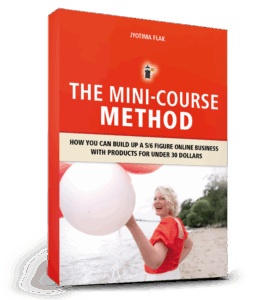
That’s exactly how my own book The Mini-Course Method started. I wrote the first draft in a single day and published it as a simple A4 PDF. Later, I turned it into a paperback on Amazon KDP, with more pages and space for readers to work through their own progress.
Here’s the key: people don’t buy ebooks because they want more information. They want a solution. A path forward.
A good ebook answers only one question: How do I get from where I am now to where I want to be?
If your ebook does that, it will sell, even without a big audience.
And remember: your ebook isn’t the final product. It’s the entry point to your next offer.
Product #2: A Mini Course
Some people love to read. Others learn better by watching and listening. A mini course lets you explain your idea step by step, in video or audio.
The best part: you don’t need new content. Take the same core idea as your ebook and turn it into short video tutorials. The idea stays the same, but the experience changes.
Add a few extras, like special tips, bonuses or a guided meditation, and your mini course becomes something people love to pay for.
Keep it focused: one problem, one solution, something your customers can work through in a weekend.
Product #3: A Simple Membership
Your third product can be a small, ongoing program. It doesn’t have to be big or complicated. It can be:
a small group program
a monthly live call
an online group for guidance and support
Many people don’t fail because they lack information. They fail because they feel alone.
A membership creates connection, trust and long-term value, for your community and for your income. You get to know your members better, and they buy from you again and again.
One Idea, Three Digital Products
You don’t need a new idea for every product. One idea can become:
an ebook
a mini course
a membership for ongoing support
Think of an apple. You can eat it whole, cut it into slices, or press it into juice. It all comes from the same source, but each one is a different experience.
Your expertise works the same way.
The Simple System Behind It: The Mini-Course Method
Products alone don’t create freedom. Systems do.
Here’s how it works:
You lead people to one entry product, usually your ebook or mini course.
Once someone buys, trust is already there.
Then you offer your second product.
From there, you guide them step by step to your third offer.
That’s what I call the Mini-Course Method, and it’s how a sustainable online business is built.
Why This Is What Sells in 2026
The online world is loud and fast. But you don’t need to create something new every six weeks. It’s much smarter to build evergreen products that people buy for years.
People are tired of complicated promises. They want simple solutions that feel honest and realistic. Small products feel safe, and they inspire. And when people feel safe, they buy.
Start Small and Let Your System Grow
If you want simple ideas you can actually finish, and you want to build the whole system step by step, my book The Mini-Course Method shows you exactly how.
It shows you how to turn one clear idea into a small eBook, a mini course, and a scalable system — without a big audience and without complicated strategies.
Start small. Stay consistent. And build something that grows with you.
Yours, Jyotima
Frequently Asked Questions
What digital products should I sell in 2026?
Small, focused products sell especially well: a short ebook, a mini course or a simple membership. Each solves one clear problem and is easy for customers to say yes to.
How long should a small ebook be?
Around 30 to 40 pages is enough. What matters is that it answers one clear question and helps your reader get from A to B.
Do I need new content for every product?
No. You can turn one idea into an ebook, then teach the same idea as a mini course, and offer ongoing support in a membership. Same idea, different format.
Can I sell digital products without a big audience?
Yes. A focused product that solves one real problem can sell even to a small audience, especially when it’s part of a simple system that leads customers to your next offer.
To provide the best experiences, we use technologies like cookies to store and/or access device information. Consenting to these technologies will allow us to process data such as browsing behaviour or unique IDs on this site. Not consenting or withdrawing consent, may adversely affect certain features and functions.
Functional
Always active
The technical storage or access is strictly necessary for the legitimate purpose of enabling the use of a specific service explicitly requested by the subscriber or user, or for the sole purpose of carrying out the transmission of a communication over an electronic communications network.
Preferences
The technical storage or access is necessary for the legitimate purpose of storing preferences that are not requested by the subscriber or user.
Statistics
The technical storage or access that is used exclusively for statistical purposes.The technical storage or access that is used exclusively for anonymous statistical purposes. Without a subpoena, voluntary compliance on the part of your Internet Service Provider, or additional records from a third party, information stored or retrieved for this purpose alone cannot usually be used to identify you.
Marketing
The technical storage or access is required to create user profiles to send advertising, or to track the user on a website or across several websites for similar marketing purposes.